
How to Build a High-Performance Engineering Culture in Distributed Teams

Building a distributed engineering team is easier than building a high-performance engineering culture. Many organizations successfully hire talented developers across multiple countries, yet struggle to create the alignment, ownership, and collaboration that separate exceptional engineering teams from average ones.
In today’s remote-first world, engineering culture is no longer shaped by office interactions or spontaneous hallway conversations. Instead, it is built intentionally through leadership, communication, shared values, and consistent engineering practices. When done well, a strong engineering culture improves developer engagement, accelerates delivery, increases software quality, and significantly reduces turnover across distributed teams.
In this guide, you’ll learn the essential principles of a high-performance engineering culture, practical strategies for strengthening collaboration across distributed teams, common mistakes that limit performance, and the leadership practices that help offshore and remote engineers perform as one unified organization.
Why Distributed Teams Need an Intentional Culture Strategy
In a traditional office, culture develops organically through daily interactions, shared experiences, and informal conversations. Engineers overhear technical discussions, build trust over coffee, and naturally absorb how decisions are made. In distributed teams, those opportunities are far less frequent. Without a deliberate culture strategy, every remote office or offshore team can begin operating as its own organization, creating inconsistencies that slow delivery and weaken collaboration.
An intentional engineering culture provides the shared operating system that keeps distributed teams aligned regardless of geography. It establishes common expectations for communication, decision-making, ownership, and engineering excellence so everyone works toward the same goals in the same way.
Several challenges make this especially important for distributed teams:
- Communication gaps. Time zone differences and asynchronous work can delay decisions or create misunderstandings when communication standards are unclear.
- Knowledge silos. Important context often remains within individual teams or locations if documentation and knowledge sharing aren't prioritized.
- Lower visibility. Remote engineers may struggle to understand how their work contributes to larger business objectives, reducing engagement and ownership.
- Inconsistent engineering practices. Without shared standards, teams may adopt different approaches to code reviews, testing, documentation, and deployment, making collaboration more difficult.
- Reduced trust across locations. When people rarely interact outside scheduled meetings, it's harder to build the relationships that enable honest feedback, fast problem-solving, and effective teamwork.
The strongest distributed engineering organizations don’t leave culture to chance. They intentionally design it through leadership behaviors, standardized engineering practices, transparent communication, and systems that reinforce collaboration every day. As a result, engineers identify with one team—not separate offices or regions—and can deliver software with the speed, consistency, and quality of a co-located organization.
The Pillars of High-Performance Engineering Culture
A high-performance engineering culture isn’t built around perks or motivational slogans. It’s built around behaviors and systems that consistently help engineers produce high-quality software, solve problems collaboratively, and continuously improve. While every organization has its own values, the strongest distributed engineering teams tend to share several foundational pillars.
Ownership Over Task Completion
High-performing engineers don’t simply complete tickets—they take responsibility for outcomes. They understand the business problem they’re solving, proactively identify risks, suggest improvements, and remain accountable after deployment.
Leaders can encourage ownership by:
- Giving engineers context behind product decisions.
- Defining success in terms of business outcomes rather than completed tasks.
- Empowering developers to make technical decisions within clear guidelines.
- Celebrating initiative, not just execution.
Transparent Communication
Distributed teams rely on communication more than proximity. Clear documentation, thoughtful asynchronous updates, and open discussions reduce misunderstandings and help everyone stay aligned regardless of time zone.
Strong communication practices include:
- Maintaining clear engineering documentation.
- Recording architectural decisions.
- Sharing project updates proactively.
- Encouraging questions and constructive feedback.
- Using meetings only when they add value.
Transparency reduces friction and helps every engineer make informed decisions independently.
Psychological Safety
Innovation depends on people feeling comfortable speaking up. Engineers should be able to challenge ideas, admit mistakes, ask questions, and propose improvements without fear of blame or embarrassment.
Psychological safety can be strengthened by:
- Treating mistakes as learning opportunities.
- Running blameless postmortems.
- Encouraging respectful technical debates.
- Focusing code reviews on improving code—not criticizing people.
- Actively inviting input from quieter team members.
Teams that feel safe communicate earlier, solve problems faster, and continuously improve.
Continuous Learning
Technology evolves constantly, and engineering culture should encourage continuous growth rather than expecting developers to learn independently in their spare time.
Leading organizations promote learning by:
- Hosting internal technical talks.
- Running knowledge-sharing sessions.
- Supporting mentorship programs.
- Providing access to training resources.
- Encouraging experimentation with new technologies, including AI-assisted development tools.
Learning cultures stay adaptable and are better prepared for future technical challenges.
Engineering Excellence
High-performing teams share a commitment to building software the right way—not simply delivering it quickly. Engineering excellence comes from consistent standards that make quality everyone’s responsibility.
Core practices include:
- Thorough code reviews.
- Automated testing.
- Continuous integration and deployment (CI/CD).
- Managing technical debt proactively.
- Regular refactoring.
- Clear coding standards and documentation.
These practices create a foundation for sustainable delivery, allowing teams to move faster over time instead of accumulating costly shortcuts.
Shared Purpose and Customer Focus
The most effective engineering teams understand how their work contributes to customer success. When developers see the impact of their decisions, they’re more engaged, make better trade-offs, and prioritize work that delivers real business value.
Engineering leaders can reinforce this mindset by:
- Sharing customer feedback regularly.
- Explaining the business goals behind technical initiatives.
- Involving engineers in product discussions.
- Celebrating customer outcomes—not just release milestones.
When everyone understands the mission, distributed teams stay aligned even when working independently.
Leadership Practices That Strengthen Engineering Culture
Engineering culture is shaped less by written values than by the daily actions of leaders. Developers pay attention to what managers prioritize, reward, and tolerate. If leadership emphasizes collaboration, ownership, and continuous improvement, those behaviors become part of the team’s culture. If leaders focus only on output and deadlines, culture quickly shifts toward short-term execution at the expense of long-term performance.
For distributed teams, intentional leadership is even more important because engineers have fewer opportunities to learn through observation. Leaders must actively create consistency across locations, time zones, and functions.
Set Clear Expectations
High-performing teams know what success looks like. Engineering leaders should establish clear standards for communication, code quality, documentation, collaboration, and decision-making so every engineer understands how work gets done.
Consistency reduces confusion and helps new team members become productive more quickly.
Lead With Context, Not Control
Micromanagement slows distributed teams and discourages ownership. Instead of prescribing every solution, effective leaders explain the business goals, constraints, and desired outcomes, then trust engineers to determine the best technical approach.
Giving developers context empowers them to make smarter decisions independently.
Prioritize Regular One-on-One Conversations
One-on-one meetings aren’t simply status updates—they’re opportunities to understand challenges, provide coaching, discuss career growth, and identify obstacles before they become larger problems.
Consistent check-ins also help remote engineers feel connected to the organization, even when working thousands of miles from headquarters.
Recognize Great Work Publicly
Recognition reinforces the behaviors leaders want to see repeated. Celebrating collaboration, knowledge sharing, mentoring, innovation, and customer impact sends a stronger message than rewarding only individual productivity.
Public recognition also helps create a sense of belonging across distributed teams.
Encourage Cross-Team Collaboration
Engineering culture grows stronger when knowledge flows freely across teams rather than remaining within individual projects or locations.
Leaders can encourage collaboration by:
- Pairing engineers from different offices.
- Rotating ownership of technical initiatives.
- Hosting architecture reviews and knowledge-sharing sessions.
- Building communities around technical specialties.
- Creating opportunities for engineers to solve problems together.
These interactions strengthen relationships while reducing knowledge silos.
Measure Outcomes, Not Activity
High-performing engineering organizations evaluate success based on results rather than visible effort. Metrics like customer impact, delivery reliability, software quality, and team health provide a far more accurate picture than hours worked or meeting attendance.
Focusing on outcomes encourages autonomy while maintaining accountability.
Make Feedback a Continuous Process
Annual performance reviews alone aren’t enough to improve engineering performance. The strongest teams create ongoing feedback loops where engineers regularly receive coaching, exchange ideas during code reviews, and participate in retrospectives focused on continuous improvement.
Frequent, constructive feedback enables teams to adapt quickly and maintain high standards over time.
Build Trust Through Consistency
Trust is one of the most valuable assets in a distributed engineering organization. Leaders build trust by communicating transparently, following through on commitments, treating every location equally, and making decisions based on clear principles rather than proximity to headquarters.
When engineers trust their leaders—and one another—they collaborate more effectively, take greater ownership, and remain engaged for the long term.
Leadership Defines Culture
Processes, tools, and documentation all contribute to engineering culture, but leadership determines whether those systems become meaningful habits. By consistently modeling the behaviors they expect from their teams, engineering leaders create an environment where distributed engineers can collaborate confidently, innovate continuously, and perform at their highest level regardless of where they work.
Metrics That Indicate a Healthy Engineering Culture
Engineering culture can feel intangible, but its impact is measurable. While no single KPI can capture the health of a team’s culture, a combination of engineering, business, and people metrics can reveal whether your distributed team is truly performing at a high level.
The key is to look beyond productivity alone. A healthy engineering culture produces engaged developers, efficient collaboration, high-quality software, and sustainable delivery over time.
| Metric | What It Reveals | Why It Matters |
|---|---|---|
| Developer Retention | Whether engineers choose to stay with the company | High retention often reflects strong leadership, career growth opportunities, and a positive engineering culture. |
| Employee Engagement (eNPS or surveys) | How connected and motivated engineers feel | Engaged teams are more collaborative, innovative, and committed to long-term success. |
| Lead Time for Changes | How quickly code moves from development to production | Shorter lead times often indicate efficient collaboration, mature engineering practices, and fewer bottlenecks. |
| Deployment Frequency | The team's ability to deliver value consistently | Frequent, reliable deployments suggest confidence in engineering processes and automation. |
| Change Failure Rate | The percentage of deployments causing incidents or rollbacks | Low failure rates reflect strong testing, code quality, and engineering discipline. |
| Mean Time to Recovery (MTTR) | How quickly the team resolves production issues | Fast recovery demonstrates effective collaboration, ownership, and operational maturity. |
| Pull Request Review Time | How efficiently engineers collaborate on code | Timely reviews promote knowledge sharing, maintain development velocity, and reduce developer frustration. |
| Knowledge Sharing Participation | Contribution to documentation, tech talks, or mentoring | Active knowledge sharing indicates a culture focused on learning rather than individual expertise. |
| Internal Mobility and Promotions | Opportunities for career development | Organizations that develop talent internally typically build stronger engagement and retain top engineers longer. |
Common Mistakes That Hurt Distributed Engineering Culture
Even companies with talented engineers and modern technology can struggle to build a strong engineering culture. In distributed teams, small leadership missteps are often amplified by distance, making it easier for misalignment, disengagement, and communication breakdowns to take hold.
The good news is that most culture-related issues are preventable. Recognizing the common pitfalls is the first step toward building a more connected and high-performing engineering organization.
Treating Offshore Engineers as External Vendors
One of the biggest mistakes organizations make is creating an “us versus them” dynamic. When offshore developers are excluded from planning sessions, product discussions, or strategic decisions, they naturally become task executors rather than true engineering partners.
How to avoid it: Include distributed engineers in planning, architecture discussions, retrospectives, and company-wide communication. Everyone should understand the product vision and have a voice in how it’s built.
Measuring Activity Instead of Impact
Tracking hours worked, online status, or the number of tickets completed encourages engineers to optimize for output rather than value. High-performing teams focus on solving problems—not simply staying busy.
How to avoid it: Measure business outcomes, software quality, customer impact, and team collaboration instead of individual activity metrics.
Relying Too Heavily on Meetings
Many distributed organizations try to compensate for distance by scheduling more meetings. Ironically, excessive meetings reduce focus time, slow decision-making, and create unnecessary fatigue across multiple time zones.
How to avoid it: Adopt an asynchronous-first communication model where documentation, written updates, and recorded decisions become the default, reserving meetings for collaboration that genuinely benefits from real-time discussion.
Ignoring Documentation
When critical knowledge exists only in conversations or the minds of senior engineers, distributed teams struggle to move quickly. New hires onboard more slowly, decisions are repeated, and knowledge becomes siloed.
How to avoid it: Build a documentation culture where architecture decisions, engineering standards, workflows, and technical knowledge are easy to find and regularly updated.
Inconsistent Leadership Across Teams
Culture quickly becomes fragmented when different engineering managers operate with different expectations around communication, quality standards, or performance. Engineers begin experiencing completely different cultures depending on which team they join.
How to avoid it: Establish shared leadership principles and engineering standards across the entire organization while giving managers flexibility in how they support their teams.
Neglecting Career Development
Distributed engineers who don’t see opportunities to grow are far more likely to disengage or seek new opportunities. Career development is one of the strongest drivers of long-term retention.
How to avoid it: Provide regular feedback, mentorship, learning opportunities, and transparent career paths regardless of an engineer’s location.
Building Separate Cultures Instead of One Team
When headquarters and offshore offices operate independently—with separate communication channels, traditions, or priorities—collaboration becomes increasingly difficult. Engineers identify with their location rather than the organization as a whole.
How to avoid it: Create shared rituals, celebrate achievements across all locations, encourage cross-office collaboration, and reinforce one unified engineering culture.
Assuming Culture Will Develop Naturally
Perhaps the most costly mistake is believing that engineering culture will emerge on its own. While this may happen in small co-located teams, distributed organizations require deliberate effort. Without clear leadership, communication standards, and shared values, every team gradually develops its own way of working.
How to avoid it: Treat culture as an ongoing engineering initiative. Define the behaviors you want to encourage, reinforce them through leadership, hiring, onboarding, recognition, and performance management, and regularly measure whether the culture is evolving in the right direction.
Culture Is Built Intentionally
High-performance engineering culture isn’t created through mission statements or occasional team-building activities. It’s built through thousands of everyday decisions—how leaders communicate, how engineers collaborate, how success is measured, and how people are supported. Organizations that avoid these common mistakes create distributed teams that operate with greater trust, stronger ownership, and consistently better engineering outcomes.
Building Culture Across Offshore Engineering Teams: A Practical Checklist
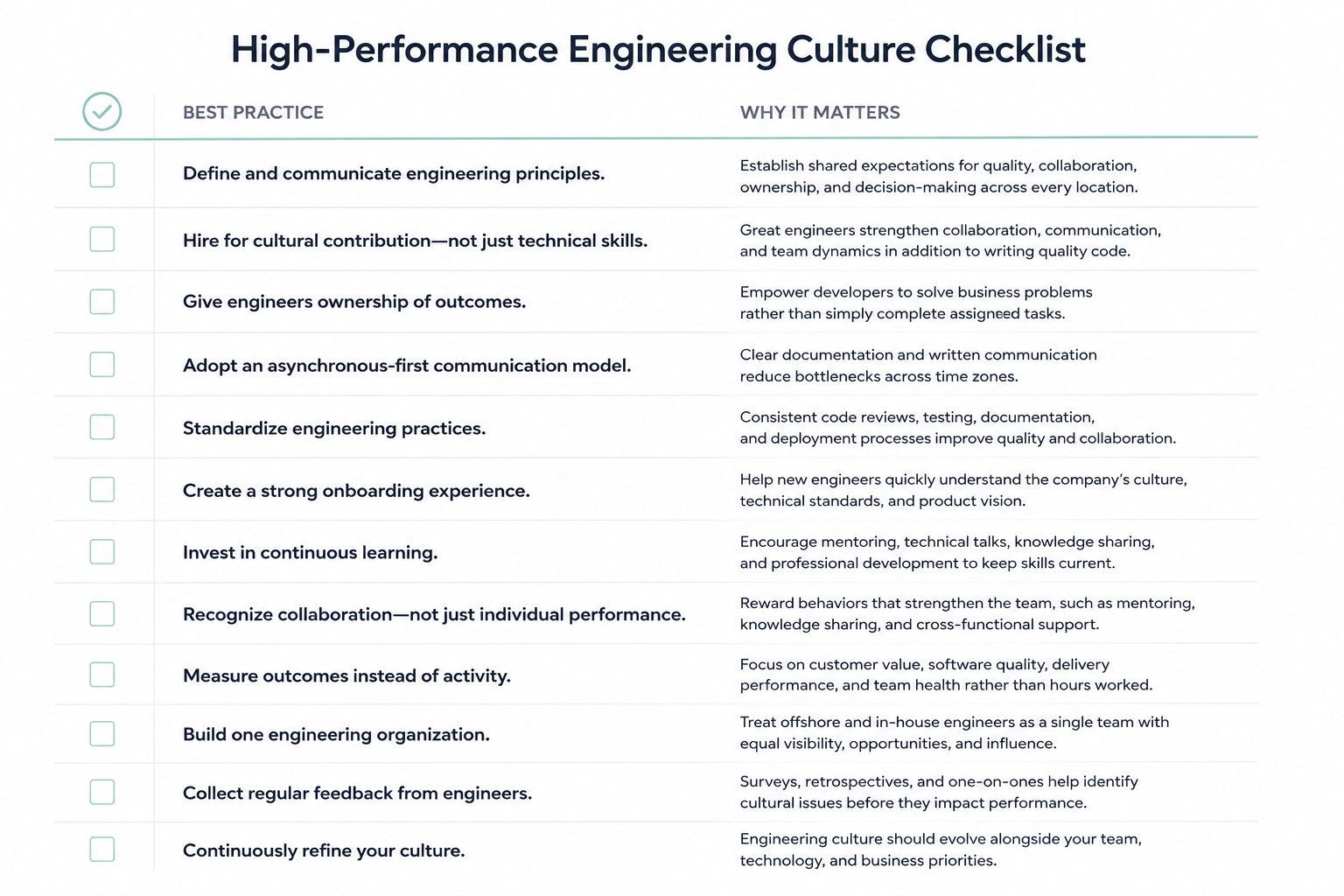
Creating a high-performance engineering culture doesn’t require a complete organizational overhaul. In most cases, it’s the result of consistent habits, clear expectations, and leadership behaviors that are reinforced over time.
Use the checklist below to evaluate whether your distributed engineering team has the cultural foundations needed to perform at its best.
How TurnKey Helps Companies Build High-Performance Distributed Engineering Teams
At TurnKey, we believe high-performance engineering culture starts long before an engineer writes their first line of code. It begins with hiring the right people, creating an environment where they can thrive, and giving companies the operational support needed to build stable, engaged, and collaborative distributed teams.
Rather than acting as a traditional staffing vendor, TurnKey partners with technology companies to build offshore engineering teams that function as a seamless extension of their in-house organization.
Here’s how we help our clients create high-performing distributed teams:
- Custom recruiting for every role. We recruit specifically for each position, evaluating candidates not only for technical expertise but also for communication skills, problem-solving ability, and cultural alignment with your engineering team.
- Industry-leading talent retention. Our unique retention program reduces developer churn by more than 50% compared to the industry average, helping clients preserve institutional knowledge, improve team stability, and reduce hiring costs.
- Complete salary transparency. Through our cost-plus pricing model, clients have full visibility into developer compensation and service fees, creating trust and ensuring engineers are paid competitively.
- Employer of Record (EoR) expertise. Our international legal, payroll, HR, and compliance specialists manage the complexities of employment across Eastern Europe and Latin America, allowing your team to focus on building products instead of navigating local regulations.
- Dedicated client success support. Every engagement includes ongoing support to help maintain strong communication, quickly resolve challenges, and ensure offshore engineers remain fully integrated into your engineering organization.
- Scalable teams built for long-term growth. Whether you're adding a few specialists or building an entire engineering center, we help create teams that can scale while maintaining consistent engineering standards and culture.
One Team, Regardless of Location
The most successful distributed engineering organizations don’t distinguish between “headquarters” and “offshore.” They operate as one team with shared goals, shared standards, and shared ownership.
That’s the philosophy behind every TurnKey engagement. By combining custom recruiting, transparent operations, exceptional retention, and comprehensive legal and HR support, we help companies build distributed engineering teams that collaborate effectively, innovate confidently, and deliver lasting business value.
Let's build your amazing offshore team together
FAQs
A high-performance engineering culture is an environment where developers consistently deliver high-quality software while collaborating effectively, taking ownership of outcomes, and continuously improving their skills and processes. It is built on shared values such as trust, transparency, accountability, and engineering excellence, rather than relying solely on technical talent.
Building a strong engineering culture requires intentional leadership. Organizations should establish clear engineering principles, standardize communication and development practices, encourage ownership, invest in continuous learning, and create opportunities for collaboration across locations. Just as importantly, offshore engineers should be treated as integral members of the engineering organization, not as external resources.
A strong engineering culture helps offshore teams work as a seamless extension of in-house teams. It improves collaboration, increases developer engagement, reduces turnover, accelerates knowledge sharing, and leads to higher software quality. Companies that invest in culture often see better delivery performance and stronger long-term business outcomes than those that focus solely on technical skills or cost savings.
TurnKey Staffing provides information for general guidance only and does not offer legal, tax, or accounting advice. We encourage you to consult with professional advisors before making any decision or taking any action that may affect your business or legal rights.
Tailor made solutions built around your needs
Get handpicked, hyper talented developers that are always a perfect fit.
Let’s talkPlease rate this article to help our team improve our content.
Here are recent articles about other exciting tech topics!


How to Measure Offshore Engineering Team Performance Beyond Velocity

Building Award-Winning WealthTech in Latin America with Offshore Developers

Developers’ Churn Risk Management for Mission-Driven Health Startups

CTO Mentoring – Unlocking Success for CTOs and Companies