
AI Transformation Services Without Building an Internal AI Team
👍 Rating — 5 (1 vote)

Most companies don’t have an AI tool problem. They have an AI operations problem.
AI initiatives get scattered across teams, workflows break, costs rise, and internal engineering teams get pulled away from core product work — all before AI delivers meaningful business value.
That’s why more companies are shifting away from building massive in-house AI departments and instead focusing on something far more important: creating a centralized AI foundation that actually makes artificial intelligence operational across the business.
Why Most AI Adoption Initiatives Break Down Inside Companies
Only 28% of AI use cases fully succeed and meet ROI expectations, according to Gartner’s 2026 survey of infrastructure and operations leaders. And in the majority of cases, this happens because AI gets introduced without a unified operational foundation behind it.
What usually starts as a few promising experiments quickly turns into fragmentation. One department uses generative AI, e.g., ChatGPT, for content. Another buys automation tools. Engineering builds internal scripts. Operations tests AI copilots. Everyone moves fast — but nobody is working within the same system.
The result is disconnected workflows, duplicated spending, inconsistent data handling, and growing security risks. Instead of making the company more efficient, AI often creates a new layer of operational chaos.
Another major issue is ownership. AI transformation rarely fits neatly into a single department. Engineering teams are already focused on core product development. Tech teams manage infrastructure and security. Operations teams care about process efficiency. Leadership wants measurable business outcomes. Without centralized governance, AI initiatives end up scattered across the organization with no clear long-term direction.
Hiring an internal AI team is not always the solution either. The AI ecosystem evolves too quickly, and many companies struggle to define what roles they even need, let alone hire and retain them. Building an internal AI function often requires expensive specialists, new infrastructure, operational oversight, and continuous maintenance long before the company sees meaningful ROI.
That’s why many AI projects stall after the experimentation phase. The issue is rarely access to AI models or tools. The real challenge is building realistic and viable AI strategies and operationalizing AI in a scalable, secure, and sustainable way across the business.
How TurnKey AI Solutions Approaches AI Transformation
TurnKey AI Solutions approaches AI transformation as an operational challenge.
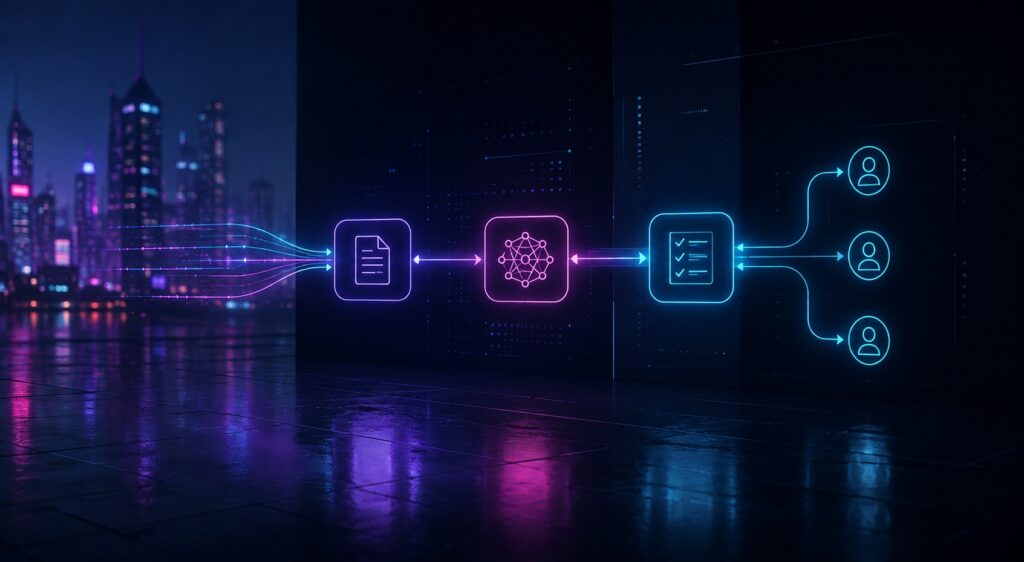
Most companies already have access to AI tools. The real issue is that those tools are often disconnected, unmanaged, and difficult to scale across the organization. Instead of creating another isolated AI initiative, TurnKey focuses on building a centralized AI foundation layer that integrates directly into the company’s existing systems and workflows.
Building on Top of Existing Infrastructure
Rather than replacing internal systems, TurnKey builds AI capabilities on top of the tools companies already use every day, including:
- CRM platforms
- ERP systems
- Finance tools
- HRIS platforms
- Internal databases
- Custom business applications
This allows AI workflows, automations, and agents to operate inside real business processes instead of functioning as disconnected experiments.
A Continuous Operational Model
TurnKey’s approach is designed around four core stages:
Define
First, the team identifies which workflows should actually be automated, prioritized, and optimized based on business impact — not hype.
Build
TurnKey then develops custom AI agents, automations, and orchestration layers tailored to the company’s infrastructure and operational needs.
Operate
Once deployed, the systems are actively monitored for performance, output quality, uptime, cost efficiency, and operational reliability.
Improve
AI systems are continuously optimized and expanded over time as workflows evolve, models improve, and business needs change.
Why Continuous Operations Matter
One of the biggest misconceptions around AI transformation is that deployment is the finish line. In reality, AI systems require ongoing maintenance, monitoring, governance, and optimization to remain effective.
Without centralized oversight, companies often run into workflow drift, inconsistent outputs, rising infrastructure costs, and growing security risks. TurnKey’s model is built to prevent that operational fragmentation before it becomes a larger problem.
Flexibility Without Vendor Lock-In
The model is also intentionally flexible. Companies can operationalize AI quickly without immediately hiring and structuring a full internal AI department. At the same time, they maintain long-term control over their infrastructure and workflows.
And if the company eventually decides to bring AI operations fully in-house, TurnKey can help hire and transition a dedicated internal team without losing institutional knowledge or disrupting the operational foundation already in place.
Real-World Use Cases for Operational AI
Operational AI is not about replacing entire teams or turning every workflow into a chatbot. In most businesses, the biggest value comes from automating repetitive processes, improving visibility, and helping teams move faster with less manual work.
When AI is connected directly to existing systems and workflows, it becomes a practical operational layer that supports day-to-day execution across departments.
Go-To-Market Teams
Sales and marketing teams often deal with large amounts of repetitive administrative work that slows down execution and creates inconsistencies across systems.
Operational AI can help automate:
- Lead qualification and enrichment
- CRM updates and data cleanup
- Proposal and sales document generation
- Outbound personalization workflows
- Internal sales copilots and knowledge retrieval
Instead of constantly switching between disconnected tools, teams can work inside AI-driven workflows that are automatically updated, monitored, and optimized in real time.
Operations Teams
Operations is one of the areas where centralized enterprise AI infrastructure can create immediate efficiency gains.
Common use cases include:
- Workflow automation across departments
- Internal AI copilots for employees
- Ticket routing and operational support
- Process optimization and bottleneck detection
- Automated reporting and status tracking
The goal is not simply automation for its own sake, but reducing operational friction while improving consistency and visibility across the organization.
Finance Teams
Finance departments often rely on repetitive manual workflows that consume significant time and create delays in reporting and analysis.
Operational AI can support:
- Reporting automation
- Forecasting support
- Financial data processing workflows
- Internal financial knowledge systems
- Automated reconciliation and categorization tasks
Because these workflows often involve sensitive business data, centralized governance and monitoring become especially important.
Internal Knowledge and Productivity
Many companies also use operational AI to improve internal access to information and reduce the amount of time employees spend searching across disconnected systems.
Examples include:
- Company-wide AI copilots
- Internal documentation search
- Cross-platform knowledge retrieval
- Employee onboarding assistance
- Workflow guidance and support systems
When implemented correctly, these AI-powered systems help teams move faster without creating additional operational complexity.
Should Enterprises Build AI Capabilities Internally?
For many companies, the instinctive reaction to AI transformation is: “We should probably build an internal AI team.”
In some cases, that absolutely makes sense. But for many organizations, building internal AI capabilities too early creates more complexity than value.
The reality is that operationalizing AI requires far more than hiring a few AI engineers. Companies also need infrastructure, governance, monitoring, workflow integration, maintenance processes, and long-term operational ownership. And because the AI ecosystem changes so quickly, many businesses struggle to even define what an internal AI organization should look like.
When Building Internally Makes Sense
Internal AI teams are often the right choice when AI becomes a long-term strategic differentiator for the business itself.
For example:
- AI is core to the company’s product or revenue model
- The organization already has mature engineering and data infrastructure
- There is enough operational scale to justify dedicated internal ownership
- The company plans to invest heavily in proprietary AI systems long-term
In these cases, building internal expertise can create a strong competitive advantage over time.
Why Many Companies Start Externally Instead
For most businesses, the immediate goal is not to become an AI company. The goal is to make operations more efficient, reduce manual work, improve visibility, and accelerate execution.
That is why many organizations now choose to operationalize AI through external partners first rather than building a full internal AI department from day one.
This approach gives companies:
- Faster time-to-value
- Immediate access to specialized expertise
- Lower hiring and organizational risk
- Reduced operational overhead
- The ability to learn what actually works before scaling internally
Instead of spending months building teams and infrastructure, businesses can focus on deploying AI into real workflows much faster.
The Hybrid Approach Is Becoming More Common
Increasingly, companies are adopting a hybrid model.
They start by working with an operational AI partner to build and manage the foundational layer, automate workflows, establish governance, and operationalize systems across departments. Then, over time, they selectively bring certain capabilities in-house once the operational structure is mature enough to support it.
This model gives companies flexibility without forcing them into long-term vendor lock-in or premature hiring decisions.
The Bigger Question Companies Should Ask
The question is no longer simply: “Should we hire an internal AI team?”
The more important question is:
“How do we operationalize AI effectively without creating unnecessary complexity, risk, and overhead?”
For many businesses, solving that operational challenge matters far more than deciding who technically owns the infrastructure on day one.
If you want to make AI operational without building a full internal AI team, TurnKey Tech Staffing can help you get there faster and with far less operational overhead.
FAQs
AI transformation services help companies operationalize AI across their business by building workflows, infrastructure, automations, governance systems, and ongoing operational support. The goal is not just to use AI tools, but to integrate AI into real business processes in a scalable and sustainable way.
Not always. Many companies successfully operationalize AI through external partners instead of building full in-house AI departments. This allows them to access specialized expertise, reduce hiring complexity, and achieve faster time-to-value while maintaining flexibility for the future.
Most AI initiatives fail because of operational fragmentation rather than bad technology. Common problems include disconnected tools, lack of governance, unclear ownership, security risks, and the absence of a centralized AI infrastructure that connects workflows across departments.
TurnKey Staffing provides information for general guidance only and does not offer legal, tax, or accounting advice. We encourage you to consult with professional advisors before making any decision or taking any action that may affect your business or legal rights.
Tailor made solutions built around your needs
Get handpicked, hyper talented developers that are always a perfect fit.
Let’s talkPlease rate this article to help our team improve our content.
Here are recent articles about other exciting tech topics!

AI Workflow Automation: How to Identify the Right Processes First

AI Cost Optimization: How to Reduce Enterprise AI Costs Without Sacrificing Performance

What Is AI Agent Orchestration? Building Reliable Multi-Agent Workflows

Deploying AI That Actually Works: Enterprise AI Deployment Best Practices